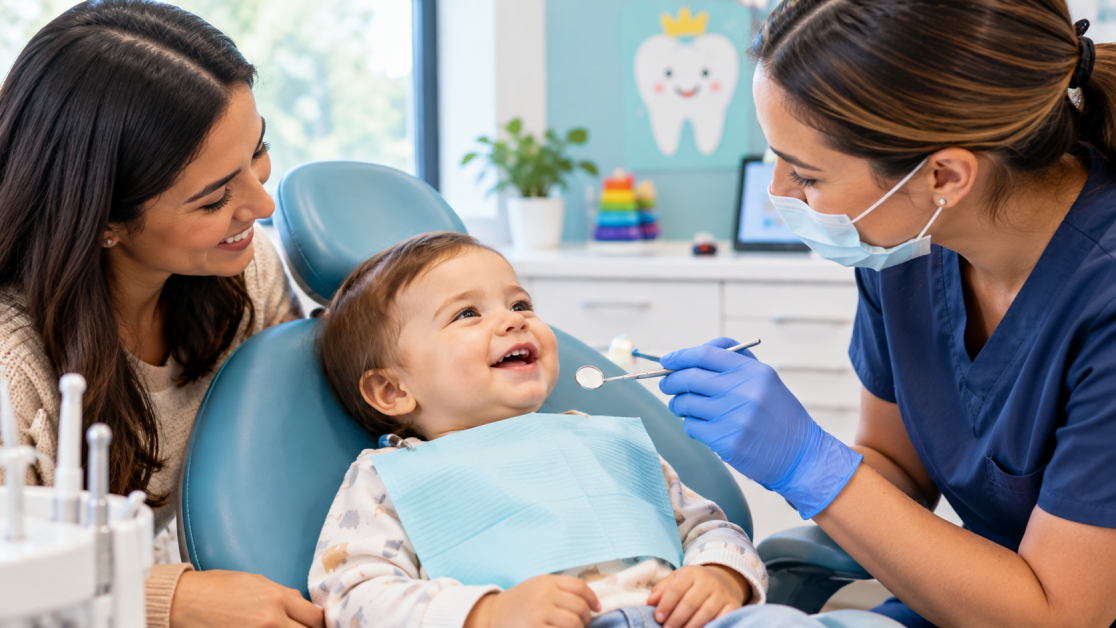
A cavity does not announce itself. It does not come with obvious pain, visible holes, or a child saying something feels wrong. Most of the time, a parent has no idea their child has one until a dentist finds it during a routine exam.
That moment can bring a flood of questions. Is it serious? Does my child actually need a filling? Why did this happen when we brush every night? And underneath all of it, the question parents rarely say out loud: did I miss something?
You probably did not miss anything. Cavities in kids’ teeth are the most common chronic childhood illness in the United States, more common than asthma. They develop quickly, do not always show obvious symptoms, and occur across all income levels, in children who brush and in those who do not. They are a disease, not a parenting failure.
At Grin Gallery Pediatric Dentistry in Chastain Park, Atlanta, Dr. Donielle Williams treats tooth decay in children the same way a good pediatrician approaches childhood illness: catch it early, treat what actually needs treatment, and do not subject a child to more than is necessary. This post explains everything parents need to understand about cavities in kids’ teeth, what they look like, why they form, and exactly how Grin Gallery handles them.
How Cavities Form in Children’s Teeth
A cavity is not simply the result of eating candy. It is the end stage of a biological process that starts with bacteria.
Every child’s mouth contains naturally occurring bacteria. When those bacteria come into contact with sugars or starches, including the kind found in crackers, juice, milk, bread, and fruit, they produce acid as a byproduct. That acid sits on the tooth surface and slowly eats away at the enamel, the hard outer layer that protects the tooth. Over time, if the acid exposure is frequent enough and the enamel does not get adequate time to recover, a weak spot forms. That weak spot deepens. Eventually, it becomes a hole. That hole is a cavity.
There are a few reasons this process moves faster in children than in adults. Baby teeth have comparatively thinner enamel than permanent teeth, which means acid reaches the inner layers of the tooth more quickly. Children also tend to have more frequent sugar exposure throughout the day, not because parents are not careful, but because healthy foods like milk, fruit, and whole-grain snacks still contain fermentable carbohydrates that feed cavity-causing bacteria. And children often cannot brush effectively on their own until they are closer to seven or eight years old, which means plaque, the sticky film where bacteria live, has more opportunity to accumulate.
None of that makes cavities inevitable. It does mean that understanding the process is the first step to getting ahead of it. The infant dentistry services at Grin Gallery guide families through cavity risk from the very first tooth.
What Do Cavities Look Like on Kids’ Teeth?
Most parents imagine a cavity as a visible hole, something obvious and dark that they should have caught. The reality is that cavities in kids’ teeth look different depending on how far along the decay is, and early cavities are very easy to miss.
1. White Spots: This is where decay begins. A chalky or dull white patch on the surface of a tooth, particularly near the gum line, is a sign that enamel is losing minerals and starting to weaken. At this stage, the damage is not yet a true cavity. With the right intervention, which includes fluoride therapy and improved oral hygiene, early enamel damage can sometimes be slowed or reversed before it becomes a hole. This stage is painless and easy to overlook.
2. Light Brown Discoloration: As decay progresses past the enamel surface, the affected area shifts from white to a light tan or brown color. This indicates a cavity has formed. The tooth is now compromised and needs clinical attention.
3. Darker Brown or Black Spots: These signal deeper decay that has moved further into the tooth. The color change reflects how far the bacteria have traveled into the tooth structure. At this stage, the cavity is more established, and treatment becomes more involved.
4. Visible Pits or Rough Edges: A child running their tongue along a tooth and saying something feels jagged, or a parent noticing an irregular surface during brushing, can indicate a cavity that has progressed enough to create a physical hole in the tooth.
5. Sensitivity or Complaints: If a child pulls away from cold drinks, winces while eating something sweet, or suddenly avoids chewing on one side, these are behavioral signals that something is happening inside a tooth. Children often cannot articulate dental pain clearly, so watch for fussing at mealtimes, refusing foods they normally like, or unexplained irritability after eating.
The important caveat is that most early cavities have no symptoms at all. A cavity between two teeth, for example, is invisible to a parent and often painless to a child for months. This is exactly why regular dental exams matter. At our practice, we use diagnostic tools, including X-rays, to detect decay in areas that cannot be seen with the naked eye, at a stage when treatment is simplest.
Do Kids Need Cavities Filled in Baby Teeth?
This is the question parents ask most often, and the answer requires some nuance.
The short answer is: often yes, but not always, and not always with a filling.
The longer answer depends on how deep the decay is, how long the tooth will remain in the mouth, and what risk the untreated cavity poses to the child’s health and to the permanent tooth developing underneath it.
1. Why baby teeth matter more than most parents think
Baby teeth are not practice teeth. They serve real, active functions while in the mouth. They help children chew and eat properly, which affects nutrition. They support clear speech development. They hold space in the jaw for the permanent teeth that will follow, acting as natural guides that keep the bone and spacing aligned. When a baby tooth is lost too early, surrounding teeth shift to fill the gap. That shift creates crowding and alignment problems for incoming permanent teeth, which can mean orthodontic treatment later.
Beyond the structural role, an untreated cavity in a baby tooth does not stay contained. Decay spreads. A cavity that starts in enamel works its way through to the inner layer of the tooth, called dentin, and eventually reaches the pulp, where the nerve and blood supply live. At that point, the tooth is infected. Any untreated infection in a baby tooth can affect the health of the permanent tooth forming directly below it. It can also cause enough pain to interfere with sleep, eating, and school performance.
2. When a filling is the right call
If decay has progressed past the enamel stage and created a true cavity, and if the tooth will remain in the mouth for another year or more, a filling is typically the appropriate treatment. The decayed tissue is removed via a minor dental procedure, and the tooth is restored to function. At Grin Gallery, Dr. Williams uses tooth-colored fillings and crowns that blend with the natural tooth and do not require removing more structure than necessary.
3. When a filling may not be needed
If decay is caught at the very earliest stage, still in the enamel and not yet a true hole, intervention does not always mean a drill. Remineralization therapy uses fluoride, calcium, and phosphate to help enamel repair itself when damage is superficial. Fluoride varnish applied in-office is a simple, non-invasive treatment that strengthens enamel and can stop early-stage decay in its tracks.
Silver diamine fluoride, known as SDF, is another option for certain cases. It is a liquid applied directly to the cavity that stops bacterial activity and arrests the decay process. It does not restore the tooth’s structure, but for a cavity that will fall out soon anyway, or for a child who is not ready for restorative treatment, it can be a clinically sound choice.
4. When more than one filling is needed
A cavity that has reached the pulp of a baby tooth may require a pulpotomy, sometimes called a baby root canal, which removes the infected tooth pulp and seals the tooth to prevent further spread. In many cases of severe tooth decay where the tooth cannot be saved, extraction and space maintenance may be necessary to protect the alignment of incoming permanent teeth.
Dr. Williams discusses all of this directly with parents. No procedure at Grin Gallery happens without a clear conversation about what the problem is, what the options are, and what is recommended and why. Over-treating a child’s teeth is not something this practice does. Under-treating a problem that will worsen is not something this practice does either.
How Grin Gallery Treats Cavities Without Over-Treating
The philosophy at Grin Gallery is to treat what needs treating with the least invasive method that is clinically appropriate, and no more.
1. Early Detection Changes Everything
The earlier a cavity is found, the more treatment options are available. A white spot lesion caught at six months requires no drill, no needle, and no filling. The same decay, if caught a year later, may require a full restoration. This is why every Grin Gallery appointment includes a careful clinical exam, age-appropriate X-rays, and documentation of any early-stage changes so they can be monitored over time. The preventive care program at Grin Gallery is built specifically around finding problems before they require significant intervention.
2. Minimally Invasive Techniques
When restorative work is needed, Grin Gallery uses approaches designed to preserve as much healthy tooth structure as possible. Air abrasion technology and the SOAA painless injector remove decay using a fine stream of particles rather than a traditional drill. It produces significantly less noise, vibration, and physical sensation, which matters particularly for anxious children. Dr. Williams also uses the SOAA painless injection system, which eliminates the sharp puncture sensation that makes numbing injections stressful for children.
3. Individualized Decisions
A five-year-old with a small cavity on a front tooth that will fall out in two years is not in the same clinical situation as an eight-year-old with a deep cavity in a permanent first molar. The right treatment depends on the child’s specific case, not a one-size-fits-all approach. Dr. Williams evaluates each tooth individually: how deep is the decay, what tooth is it, how old is the child, what is their oral hygiene like at home, and what is the risk of the cavity progressing if we monitor it versus treat it now? That individualized reasoning drives every recommendation.
4. Transparent Conversations with Parents
At Grin Gallery, parents are not presented with a treatment plan and handed a bill. Dr. Donielle Williams explains the finding, walks through the options, including any non-invasive alternatives, gives her clinical recommendation and the reasoning behind it, and answers questions. If a parent wants a second opinion, that is always their right. The goal is for parents to leave the appointment feeling informed and confident, not overwhelmed or pressured.
How to Protect Kids’ Teeth from Cavities at Home
The most effective cavity prevention happens between dental visits, in the daily routines a family builds at home.
1. Brush twice a day, every day, with the right technique
Children need supervised brushing far longer than most parents realize. The general guideline from pediatric dentistry organizations is that children should be supervised while brushing until they can tie their own shoes confidently, which, for most children, is around age 7 or 8. Before that, a child’s hand coordination is not developed enough to thoroughly clean all surfaces of their teeth.
Use a soft-bristled toothbrush sized for your child’s mouth. For children under three, use a rice-grain-sized amount of fluoride toothpaste. For children three and older, a pea-sized amount is appropriate. Brush teeth rigorously, including the backs of teeth and along the gum line, for two minutes. The preventive care page at Grin Gallery offers tips for making brushing more consistent at home.
2. Start flossing when teeth touch
As soon as two teeth are in contact with each other, the space between them becomes a place where a toothbrush cannot reach, but bacteria absolutely can. Flossing those contact points once a day removes the debris and plaque that accumulate there. For young children, floss picks or soft floss sticks are often easier to manage than traditional floss.
3. Watch what your child sips throughout the day
Juice, sports drinks, flavored milk, and even 100% fruit juice create the same acid environment as soda when they are sipped slowly over the course of a day. The frequency of sugar intake and exposure to sugary foods matters as much as the amount. A child who drinks one cup of juice with a meal clears the acid within twenty to thirty minutes as saliva neutralizes it. A child who sips on juice throughout the afternoon keeps their teeth in an acidic state for hours. Water is the best between-meal drink for protecting kids’ teeth from cavities.
4. Be thoughtful about snack frequency
Every time a child eats, even something healthy like crackers or a piece of fruit, the bacteria in the mouth begin producing acid. Structured meals and snack times give the mouth time to recover between acid exposures. Grazing throughout the day, even on seemingly harmless foods, keeps the acid cycle running continuously. This does not mean restricting food. It means being intentional about timing.
5. Ask about fluoride and sealants
Professional fluoride treatments and dental sealants at each dental visit strengthen enamel and reduce the rate of cavity formation. Pediatric dental sealants are thin protective coatings that are carefully applied to the surface of molars, which have deep grooves where decay commonly begins. Sealants for kids are among the most effective preventive measures in pediatric dentistry and can significantly reduce a child’s risk of cavities. Dr. Williams will let you know at each visit whether either of these is appropriate for your child based on their current risk level.
What a Cavity Appointment at Grin Gallery Actually Looks Like
One of the biggest barriers to parents bringing their child in for cavity treatment is not knowing what to expect. So here is a straightforward description of what happens.
Before the appointment, Dr. Williams’ team reviews the child’s records and the specific tooth being treated. If the child has had anxious experiences before, that history shapes how the appointment is structured.
When you arrive, the office environment is calm and child-friendly. The team uses simple, honest language with children, telling them what will happen in age-appropriate terms before doing anything. Surprises are minimized.
If the cavity requires a filling, the area will be numbed first using a topical gel before the injection, and Dr. Williams uses the SOAA painless injection technique to make that step as comfortable as possible. For children who need extra support, nitrous oxide and sedation options are available and discussed with parents in advance.
The actual removal of decay is done conservatively, taking only the decayed tissue and leaving healthy tooth structure intact. The filling is placed, checked for proper fit, and adjusted if needed. Most children leave the appointment in good spirits, having gotten through something that felt much more manageable than they expected.
If your child’s dental issue is urgent, same-day emergency dental care is available for established patients.
The Cost of Waiting
Parents sometimes delay treatment because they are hoping the baby tooth falls out soon anyway, or because the appointment feels like too much to manage right now, or because no one has told them clearly what happens if they wait.
Here is what happens. A cavity does not stay the same size. It grows. A small cavity that could better have been treated with a simple filling becomes a larger cavity that requires more extensive work. A cavity that could have been treated in the tooth has reached the nerve and now requires a pulpotomy or a pediatric extraction. A tooth that could have been saved must be removed. What was a straightforward appointment becomes a more complex one, often more expensive and always more stressful for the child.
The earlier a cavity in a child’s tooth is treated, the simpler, quicker, and less uncomfortable the treatment is. That is not a sales point. It is basic dental biology.
Visit The Best Pediatric Dentist For Cavities Near You!
Cavities in kids’ teeth are common, often silent, and almost always treatable, especially when caught early. Baby teeth are not disposable. They hold space, support speech, enable comfortable eating, and protect the permanent teeth developing beneath them. Treating decay in primary teeth is not optional extra care. It is the right thing to do.
At Grin Gallery Pediatric Dentistry in Chastain Park, Atlanta, Dr. Donielle Williams takes a practical, measured approach to every case of childhood tooth decay. She treats what needs treating using the least invasive method that is clinically appropriate, and she ensures parents understand every step along the way.
Frequently Asked Questions
What do cavities look like on kids’ teeth?
The earliest sign of a cavity in a child’s tooth is a white, chalky spot on the enamel, often near the gum line. This indicates that minerals are being lost from the tooth surface. As decay progresses, that white spot turns light brown, then darker brown or black. In more advanced stages, the tooth may show a visible pit or rough edge. Many cavities, particularly those between teeth, have no visible signs at all and can only be detected with X-rays during a routine pediatric dental exam.
Do kids need cavities filled in baby teeth?
Often yes, but not always with a traditional filling. The right and timely treatment depends on how far the decay has progressed, which tooth is affected, and how long the tooth will remain in the mouth. Very early decay can sometimes be managed with fluoride therapy or silver diamine fluoride without drilling. More advanced decay requires a filling, crown, or pulpotomy. A baby tooth that falls out prematurely can cause spacing and alignment problems for permanent teeth, so untreated decay in primary teeth is not a minor issue.
Why does my child keep getting cavities even though we brush every night?
Brushing once a day, even thoroughly, does not protect teeth during the other twenty-three hours. The frequency of intake & sugar exposure throughout the day, the absence of flossing, the use of sugary drinks between meals, and inadequate brushing technique are common contributors. Many children also brush for less than the recommended two minutes, or miss the backs of their teeth and gum line. It is also worth noting that some children are more biologically susceptible to cavities than others due to the composition of their saliva and the types of bacteria naturally present in their mouths. Dr. Williams can assess your child’s specific risk of cavities during a preventive care visit and provide personalized guidance.
How to protect kids’ teeth from cavities at home?
Kids should regularly brush their teeth twice daily with fluoride toothpaste using the correct amount for their age, under adult supervision until around age seven or eight. Floss once a day wherever teeth are in contact. Limit juice, sports drinks, and sugary snacks between meals. Water as the primary drink between meals should be endorsed by parents. Keep dental visits to every six months so professional fluoride treatments and sealants can be applied when appropriate. Building these habits early significantly reduces your child’s lifetime risk of cavities.
At what age do children typically start getting cavities?
Decay can begin as soon as the first baby tooth comes in, which happens around six months for most children. Early childhood cavities in toddlers and young children are a well-documented clinical reality, not something that only affects older kids. This is why all dental associations recommend a first dental visit by age one, giving a pediatric dentist the opportunity to assess cavity risk early and give parents prevention guidance before problems develop.
Is silver diamine fluoride safe for children?
Yes. Silver diamine fluoride is a clinically accepted, non-invasive treatment that stops the progression of active decay by killing the bacteria responsible for it. It is applied as a liquid directly to the affected area. It does not restore the tooth’s structural shape, and it leaves a dark stain on the decayed tissue, which is a concern for visible front teeth. Dr. Williams discusses whether SDF is an appropriate option as part of Grin Gallery’s minimally invasive dentistry approach, taking into account the child’s age, the location of the decay, and the parents’ preferences.
What happens if a child’s cavity is left untreated?
A cavity that is not treated continues to grow deeper into the tooth. It moves from enamel into dentin, then into the pulp, where the nerve lives. An infected pulp causes pain, often significant pain, and can lead to a dental abscess. The infection can impact the health of the permanent tooth forming below the baby tooth. It can also cause enough pain to disrupt eating, sleeping, and school performance. If your child is already experiencing tooth pain, same-day emergency care is available at Grin Gallery.
How often should my child see a dentist to catch cavities early?
Every six months is the standard recommendation for children, and it is the right interval for most. Some children with higher cavity risk may benefit from more frequent visits, perhaps every three or four months, to monitor closely and apply fluoride treatments more regularly. Dr. Williams assesses each child’s risk level at every preventive care appointment and will let you know if a different schedule makes sense for your child.